
Introduction
After spending a full month with the Nintendo Switch 2, I’ve had the chance to dive deep into its upgrades, quirks, and everything in between. Nintendo’s latest handheld-console hybrid brings notable hardware changes—but are they all for the better? Here’s what I’ve learned. Watch my video review about the Switch 2 herehttps://youtu.be/Eqmq2THcKkw
Screen and Display
Nintendo has replaced the 7-inch OLED panel from the previous model with a 7.9-inch LCD at a full HD resolution of 1920x1080p. It supports HDR and a variable refresh rate of up to 120Hz. At first glance, the larger screen made games feel more immersive and simply more fun to play. However, concerns have surfaced online about ghosting and latency. I didn’t experience any of those issues firsthand, but I was initially frustrated at the idea of paying more for what may be a lesser quality screen. Over time, I found myself enjoying the device again, but if you’re sensitive to display imperfections, this is something to keep in mind.
Joy-Con Redesign
The Joy-Cons have been redesigned with larger buttons and triggers, resulting in better ergonomics. They attach via magnets instead of the old rail system and detach with a simple press of a button. While I was initially skeptical, the magnetic design held firm during gameplay, and I never felt they were at risk of falling off. The added heft and tension in the joysticks made them feel more premium than the previous version.
Performance and Battery Life
Powered by a custom NVIDIA Tegra T239 chip with an octa-core CPU and 12 GB of LPDDR5X RAM (9 GB available for games), the Switch 2 surprised me with its performance. Cyberpunk 2077 ran smoothly in both Performance (40 FPS at 720p) and Quality modes (30 FPS). Still, you can’t fine-tune system-level settings like on devices such as the ROG Ally or Legion Go.
Battery life isn’t groundbreaking but functional. With screen brightness at 100%, I got just under two hours of gameplay—from Mario Kart World to Streets of Rage 4, then Fortnite and Fast Fusion—before the battery dropped from 100% to 17%. The battery capacity has increased to 5220 mAh (up from 4310 mAh on the OLED), but heavy gaming still drains it fast.
User Interface and Virtual Game Cards
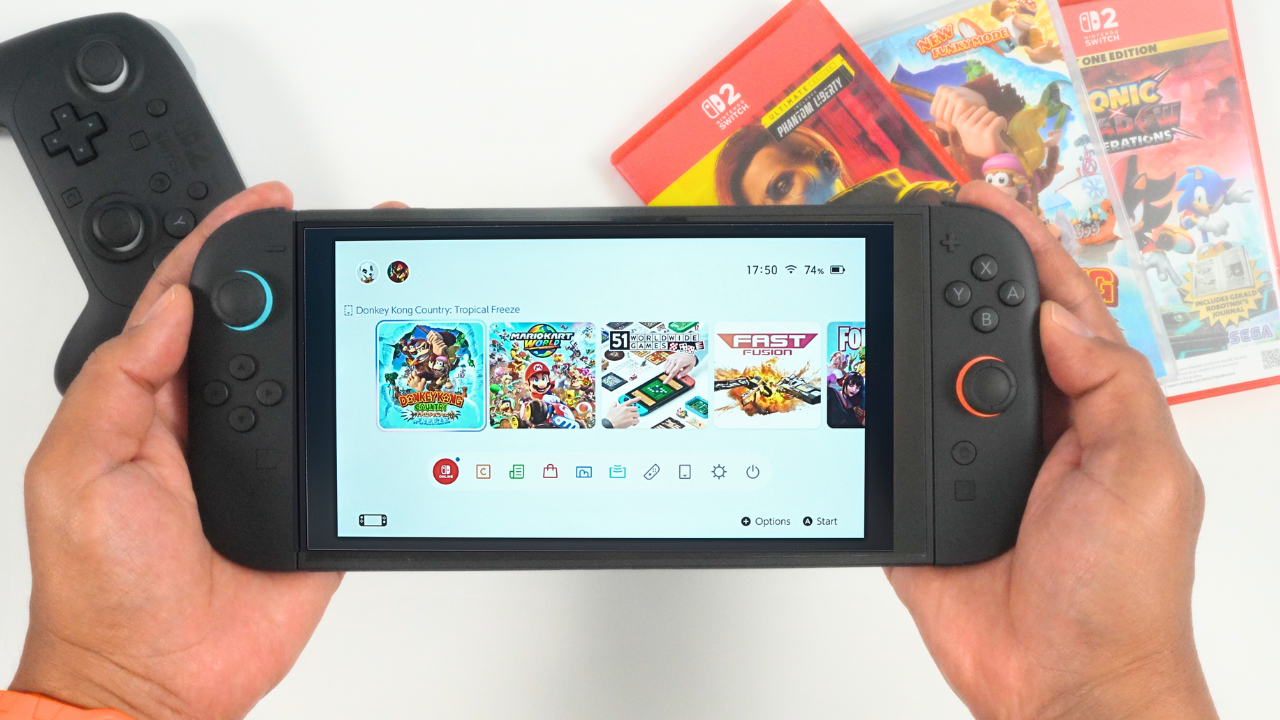
The Switch 2 keeps the user experience simple and fast. Boot-up is instant, and games appear in a clean horizontal carousel. New features like Virtual Game Cards let you transfer digital games between systems on the same account. But the process is cumbersome—requiring device pairing and game “ejection”—especially when compared to platforms like Steam, where the same library is instantly accessible across devices.
Game Sharing and Chat
Nintendo’s GameShare feature lets users on the same network share supported titles. I tested it with Clubhouse Games: 51 Worldwide Classics, and it worked well. GameChat allows up to 12 players to talk or share screens using a built-in mic and optional USB-C camera. It’s a neat feature for social gamers, but as an introvert, I haven’t used it much. Starting March 2026, GameChat will require a Nintendo Switch Online subscription.
Build and Design
The Switch 2 has a flat, minimalist design. While not as ergonomic as competitors, it’s slimmer. The kickstand has been redesigned to a U-shape, which holds its position well, though I personally prefer the solid design of the OLED’s kickstand. The microSD card slot now supports Micro SD Express for faster transfer speeds, and internal storage has increased to 256 GB.
Pro Controller and Accessories
I picked up the Switch 2 Pro Controller and found it comfortable and responsive. It supports HD Rumble, motion controls, Amiibo, and includes programmable back buttons. My favorite feature? You can wake or sleep the console from the controller—no need to leave the couch. That said, at $84, it feels overpriced.
If you’re buying a Switch 2, I recommend a few accessories: the JSAUX tempered glass screen protector, the JSAUX ergonomic grip case, and the Sisma carrying case. They add comfort and protection without compromising portability.
Games and Pricing
Game prices have gone up. Mario Kart World, for instance, retails for $80 without a bundle. That’s a steep price, especially for families. Plus, unlike other platforms, Nintendo games are locked to their ecosystem. Steam users can take their libraries across devices—Switch users cannot. That kind of lock-in matters if you’re considering which ecosystem to invest in.
Final Thoughts
The Nintendo Switch 2 isn’t competing with the ROG Ally, Steam Deck, or Legion Go. It’s targeting a different user: someone who values simplicity, fast boot times, and Nintendo’s exclusive IPs. If you love Nintendo’s games and don’t care about granular system tweaks, it’s a great upgrade. But if you prioritize flexibility and game ownership across platforms, this might not be the console for you.
Despite its shortcomings, I believe the Switch 2 will be a massive success. Just make sure it aligns with the way you like to play.