
The Lenovo Legion Go ships with a 49Wh battery. While adequate for short sessions, it has consistently been one of the device’s most limiting components in real-world use. In an effort to improve runtime and reduce charging frequency, the stock battery was replaced with an aftermarket 81Wh unit.
Initial testing showed a significant improvement in battery endurance. However, long-term usage revealed changes in performance that raised questions about how well the upgraded battery would hold up over time.
For readers interested in seeing the updated video, it is available here:
👉 https://youtu.be/PwWRJrUxZt0
Baseline: Stock Battery Performance
To establish a real-world comparison, gameplay testing was conducted using consistent performance-focused settings:
- OS Power Mode: Performance
- Fan Mode: Smart
- Thermal Mode: Performance
After approximately 60 minutes of gameplay:
| Battery | Remaining Charge After 60 Minutes |
|---|---|
| Stock 49Wh | 36% |
This level of drain reflects a common experience with the Legion Go: frequent charging and limited flexibility for extended sessions away from power.
Immediate Impact of the 81Wh Upgrade
The same test was conducted after installing the 81Wh battery.
| Battery | Remaining Charge After 60 Minutes |
|---|---|
| Upgraded 81Wh (Initial Test) | 69% |
The improvement was substantial.
The upgraded battery nearly doubled the remaining charge after one hour of performance-mode gameplay. In practical terms, this translated to:
- Fewer charging interruptions
- Longer uninterrupted sessions
- Greater flexibility when using the device away from a power outlet
Follow-Up Testing Months Later
After shifting usage to newer handhelds such as the Legion Go 2 and Xbox Ally X, the upgraded Legion Go was revisited months later.
The same gameplay test was repeated under identical settings.
| Battery | Remaining Charge After 60 Minutes |
|---|---|
| Stock 49Wh | 36% |
| Upgraded 81Wh (Initial) | 69% |
| Upgraded 81Wh (Later Test) | 56% |
While the upgraded battery continued to outperform the stock unit, its performance had declined compared to earlier results.
This suggested the possibility of capacity degradation.
Battery Health Over Time
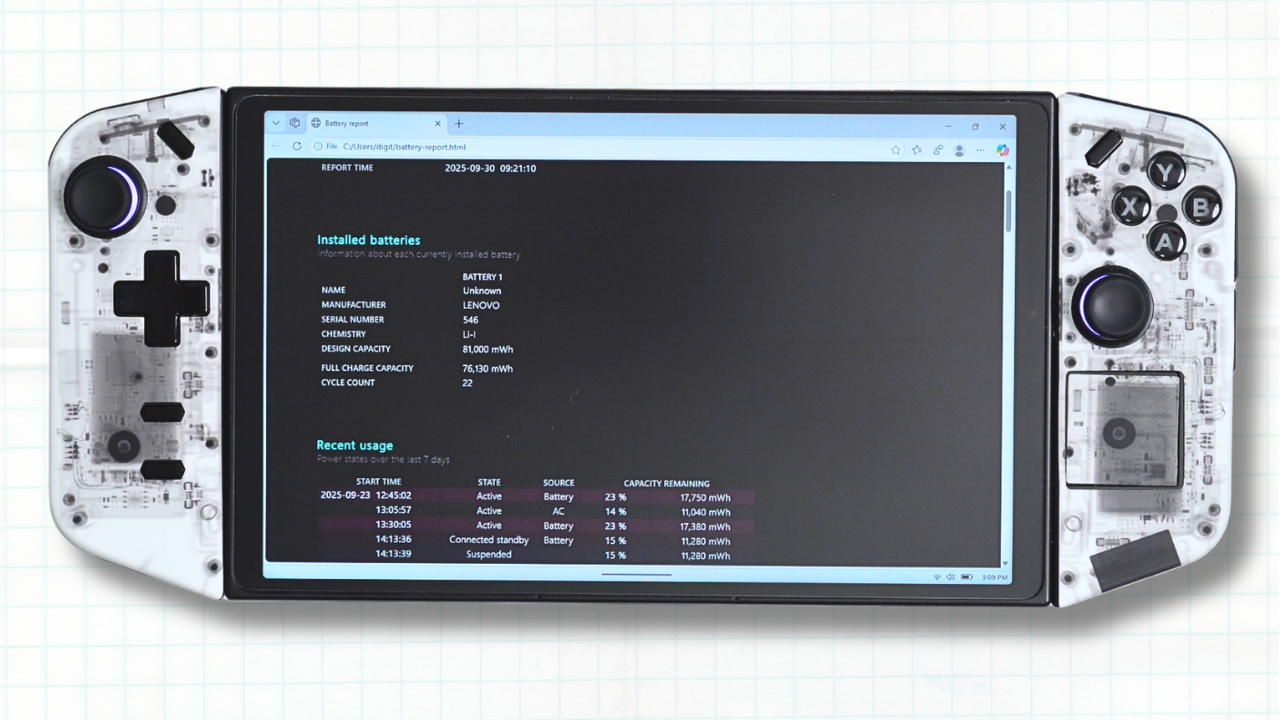
To verify this, a Windows battery report was generated at different stages of ownership. Two metrics were monitored:
- Full Charge Capacity
- Cycle Count
Capacity Decline Over Time
| Cycle Count | Full Charge Capacity |
|---|---|
| 2 cycles | 81,000 mWh |
| 22 cycles | ~76,000 mWh |
| 36 cycles | ~75,000 mWh |
The gradual drop in full charge capacity aligned with the reduced runtime observed during later testing.
While this is not a controlled scientific study—and environmental factors, usage patterns, and thermal conditions all influence battery health—it confirms that the upgraded battery experienced normal degradation over time.
Real-World Usability
Despite the measurable decline in capacity, the larger battery continued to provide noticeably longer runtime than the original 49Wh unit.
In everyday use, this translated to:
- Less urgency to recharge
- More flexibility during casual sessions
- Reduced dependence on nearby power sources
Importantly, no secondary issues were observed during long-term use:
- No overheating
- No instability
- No abnormal system behavior
Hardware Modifications: Backplate and SSD Support
The larger battery required a modified rear housing.
An initial 3D-printed backplate created space for:
- The 81Wh battery
- A 2280 SSD using an adapter
However, the snap-in SSD cover on this design became unreliable after repeated removal.
A replacement backplate was later installed featuring:
- Screw-mounted SSD retention
- Dual-screw SSD cover
This improved structural stability and long-term durability.
System checks confirmed the SSD remained healthy and fully operational.
Fit, Weight, and Accessories
The upgraded battery adds noticeable weight to the device. In practice, this did not significantly impact usability, particularly when the Legion Go is rested on a surface during play.
However, the modified backplate does affect accessory compatibility:
- Silicone protective covers may not align properly
- Full enclosure fit is reduced
Despite this, the device still fits inside:
- The original Legion Go carrying case
- Third-party zipperless leather cases
Warranty Considerations
Lenovo’s official documentation warns that improper battery replacement carries safety risks, including potential damage or failure.
Professional installation may be an option depending on location. One retail repair provider quoted approximately $60 for the service, though availability varies.
Final Assessment
Battery degradation over time is expected in any lithium-ion cell, including higher-capacity replacements.
Even accounting for this decline, the 81Wh upgrade continues to outperform the stock battery in meaningful ways. The improvement in runtime remains noticeable in everyday use and contributes to a more flexible, less restrictive handheld experience.
While the modification introduces tradeoffs—including added weight and accessory fitment challenges—it ultimately improves the Legion Go’s practicality for extended sessions.
For users comfortable with hardware modification—or those able to access professional installation—the upgrade can meaningfully extend the device’s usability.